

The collapses of Shield Master Fund and First Guardian, while still before the Federal Court, have had a devastating impact on affected investors and is likely to be a pivotal moment for the industry’s governance standards. More than 12,000 investors were affected, with approximately $1 billion of savings at risk.
From an investment governance perspective, a key issue was a lack of clarity around, or insufficient understanding of, the governance responsibilities and oversight expectations associated with managed investment schemes. The regulatory framework created a potential grey area.
Shield and First Guardian were not superannuation funds; they were managed investment schemes (MIS). Unlike superannuation trustees (RSE licensees), which operate under a well-defined and comparatively stringent governance framework designed to protect members’ retirement savings, MISs are subject to a different regulatory regime overseen by ASIC and were not specifically designed with retirement income objectives in mind.
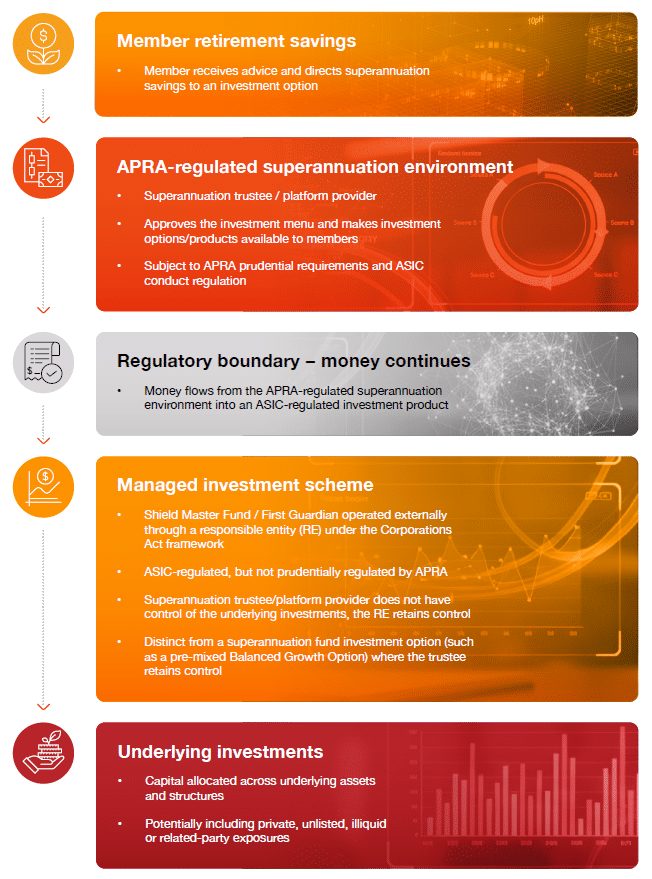
Although superannuation savings were invested in these vehicles, the MISs themselves are not regulated by APRA. Instead, they are regulated by ASIC as financial products.
Platform providers, acting as superannuation trustees, approve the products made available on their platforms. These platforms and trustees are APRA-regulated, although not all investments in Shield and First Guardian were made through APRA-regulated superannuation structures. Investments through self managed superannuation funds (SMSFs) and direct investments by private individuals are not APRA-regulated.
The Shield and First Guardian collapses illustrate the complexity of a layered financial services ecosystem, where different participants operate under different regulatory obligations, oversight arrangements and accountability frameworks.
The following flowchart provides a simplified illustration of how investors accessed Shield or First Guardian through a superannuation platform. It highlights the regulatory boundary between APRA-regulated superannuation trustees and ASIC-regulated managed investment schemes.
This complex chain of providers, which may include lead generators, licensed financial advisers, platform operators and responsible entities, each with their own profit motives, can make accountability less transparent and increase the risk that governance weaknesses are not identified or challenged in a timely manner.
APRA Prudential Standard SPS 530 – Investment Governance states “an RSE licensee is ultimately responsible for the sound and prudent management of the investments of each RSE within the RSE licensee’s business operations”.
While the Shield and First Guardian matters have raised questions about alleged misrepresentations, high-pressure sales practices and the management of conflicts of interest across product providers, lead generators, licensees and financial advisers, they have also brought into focus the adequacy of both investment and operational due diligence.
More broadly, the matters have prompted scrutiny of investment selection processes, the assessment of operational and liquidity risks, the effectiveness of ongoing monitoring, the tension between commercial incentives and prudent oversight and the ability of governance frameworks to provide meaningful challenge and oversight of complex investment structures.
In this paper, we explore the characteristics of investment-grade due diligence and the governance practices that underpin robust decision-making and oversight. We also outline Frontier’s approach to institutional due diligence and how adviser groups can benchmark their own arrangements and those of any third-party providers they engage.